ITZA, The First Layer 0 TriChain.
..that finally delivers horizontal scaling and full composability at the same time.
ITZA is the first Layer-0 that scales like the internet itself - instead of one overloaded global chain, it runs up to 65,536 parallel clusters - each a full blockchain with its own ledger, validators and fee market - all under a single, coherent protocol. The result is web-scale throughput, with the simplicity and safety of building on one chain.
Where other ecosystems rely on fragile bridges, rollups or side-chains, ITZA keeps everything inside the base layer. Cross-cluster transactions are synchronous and atomic, so complex DeFi strategies and high-performance applications can span multiple clusters in a single all-or-nothing operation.
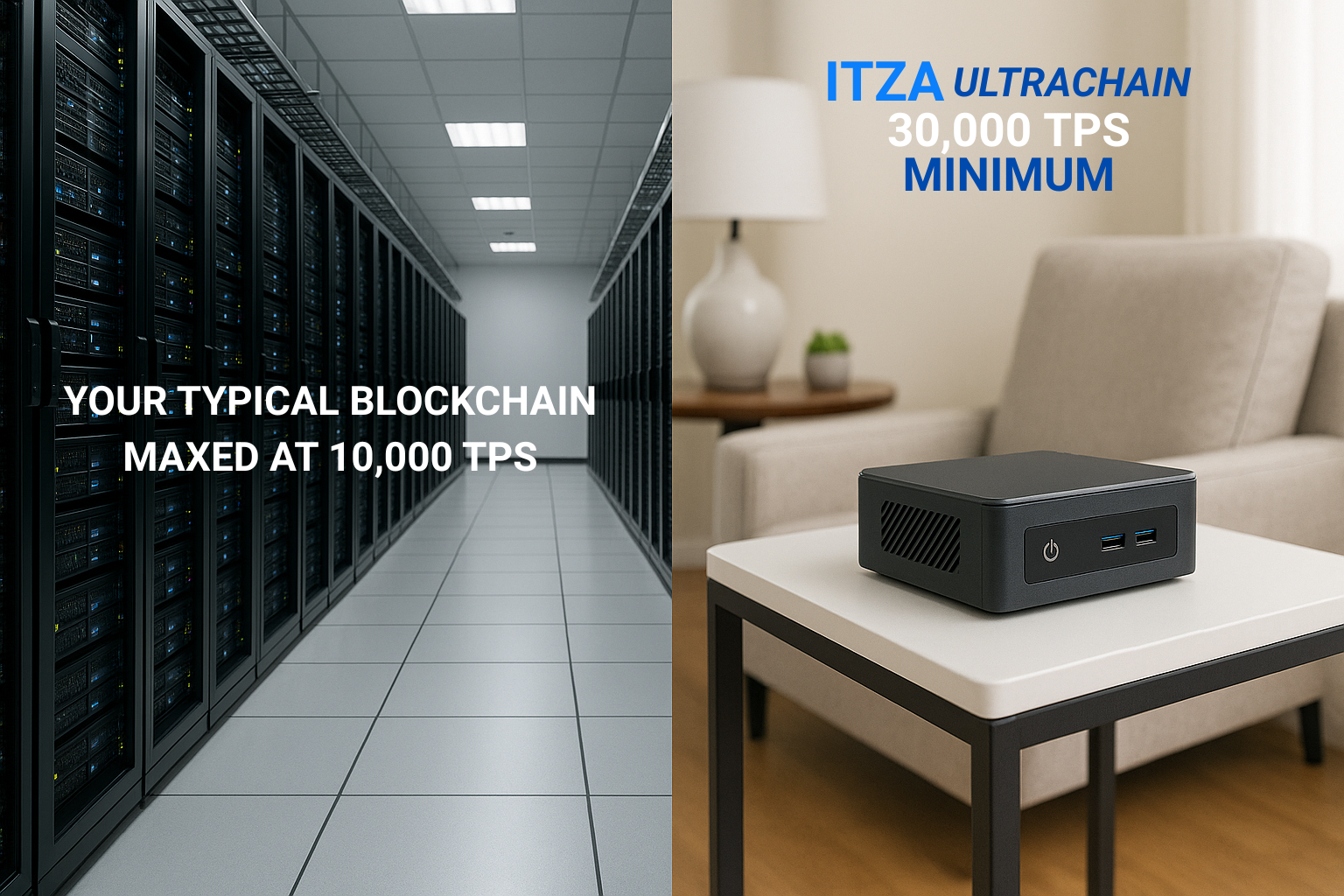
Most importantly, ITZA is designed to run on consumer-grade hardware. Clusters can be validated from home, not just from expensive data-center racks, opening the door to a truly global, highly distributed validator set.
Get the summary from this page or an in-depth analysis from this independent 13-page PDF report

How ITZA’s Cluster Architecture Works
65,536 Parallel Clusters
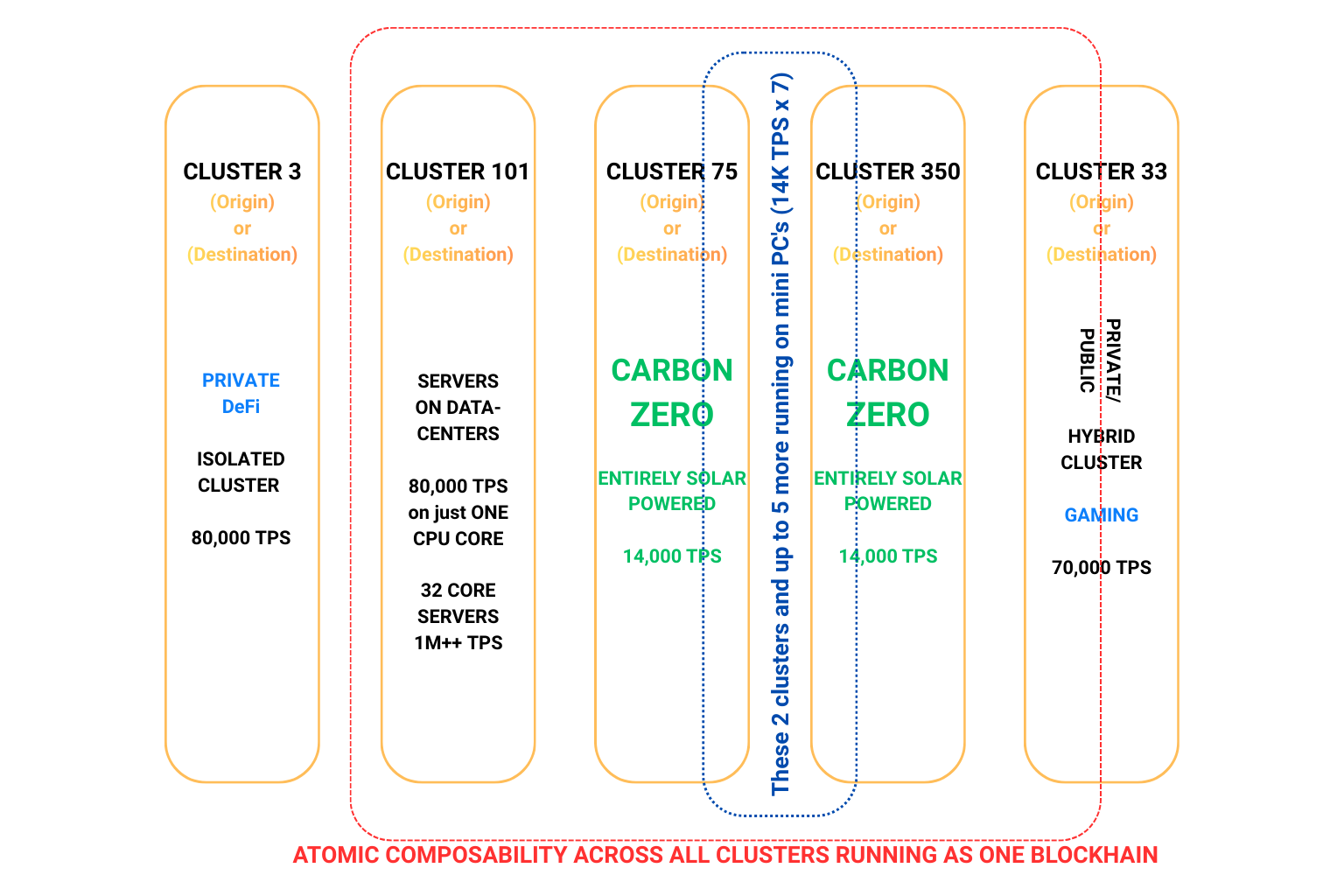
ITZA splits the network into up to 65,536 independent clusters. Each cluster behaves like a complete Layer 1 blockchain: it has its own ledger, mempool, validator set, fee rules and optional local governance. Developers can treat a cluster as “their own chain” without forking away from the main network.
Because clusters operate in parallel, network throughput scales horizontally: as demand grows, more clusters can be brought online and more validators can join. Congestion or failures in one cluster do not halt the rest of the network, providing strong fault isolation and predictable performance.
Deterministic Wallet-to-Cluster Routing
Every wallet on ITZA belongs to exactly one cluster, determined by a deterministic mapping from the wallet address itself. This means any node can instantly know where an account lives just by looking at its address - there are no routing tables, directories or central coordinators.
Wallets can be created offline and still “know” their home cluster in advance. Applications can pre-allocate address batches to specific clusters (for example, a game-only cluster or an EU-only cluster), while still remaining part of the global ITZA network.
Atomic Cross-Cluster Commit
ITZA introduces a synchronous, two-phase-style commit protocol between clusters. When a transaction touches more than one cluster, each cluster pre-validates and temporarily locks its part of the state. The transaction only becomes final if all participating clusters agree to commit; otherwise all of them roll back together.
This gives ITZA true ACID-style guarantees across clusters. A multi-cluster operation either completes everywhere or nowhere, in roughly the time it takes to confirm a normal transaction. There are no half-completed swaps, no dangling positions and no reliance on slow, asynchronous bridges.
How ITZA Compares
Ethereum and Rollups
Ethereum scales primarily by pushing execution to Layer 2 rollups and using sharding for data rather than for fully atomic execution. Cross-rollup operations are asynchronous and non-atomic, and liquidity is often fragmented across many separate environments. ITZA instead scales directly at Layer 0, keeping all clusters under one protocol with synchronous, atomic cross-cluster transactions.
Monolithic High-Speed Chains
Monolithic chains focus on making a single global ledger as fast as possible. This can achieve impressive TPS, but eventually pushes hardware requirements higher and creates a single, global bottleneck: if the main chain stalls, the entire ecosystem stalls. ITZA avoids this by splitting load across many clusters so that performance can grow horizontally while still supporting consumer-grade validator hardware.
Multi-Chain Message Fabrics
Other ecosystems connect multiple chains through message-passing protocols or bridges. These designs allow specialization, but they do not provide built-in atomic composability across chains; multi-chain operations can fail partially or require long time windows to finalize. ITZA was designed from day one to coordinate its clusters through a native atomic commit protocol, not external bridging logic.
Why ITZA Matters
Virtually Unlimited Parallelism
Because each cluster is a full blockchain, and clusters run side by side, ITZA’s aggregate throughput can scale with demand. Adding more clusters and validators increases capacity without changing the programming model developers rely on.
Home-Node Friendly Validation
Clusters can be validated from home using consumer-grade hardware. Operators are free to choose which clusters they support, allowing many smaller validators to participate rather than concentrating control in a few large data-center operators.
Full Composability, No Bridges
DeFi protocols, games, social platforms and enterprise apps can treat ITZA as one giant, composable environment, even though it is implemented as many parallel clusters. Tokens and contracts can interact across clusters in a single atomic transaction, without wrapped assets or fragile bridge contracts.
Local Control with Global Reach
Clusters can be tailored for specific regions, industries or applications, with their own parameters and governance models, while still enjoying full interoperability with the wider ITZA ecosystem. This makes ITZA suitable for public DeFi, consumer apps, and enterprise or regulatory-sensitive deployments at the same time.
Taken together, these properties make ITZA more than just another fast chain. It is a horizontally scalable, fully composable Layer 1 designed to support the next generation of web-scale applications - from on-chain finance and gaming to enterprise systems and real-world infrastructure.
